
Optional Practical Training (OPT)
Guide
Optional Practical Training (OPT) is a temporary F-1 work authorization for off-campus training that is directly related to your field of study. Learn more here!
Written by Jennifer Glass, Immigration Coordinator of the International Student Resource Center
Last updated: September, 2026
Overview
F-1 students who would like to gain work experience in the U.S. may qualify and can apply for Optional Practical Training (OPT). OPT is a temporary employment authorization that allows you to continue your learning in a workplace environment, and gain practical experience related to your academic studies. Since OPT is a benefit of F-1 status, no employer sponsorship or work visa is required.
Students are eligible for up to 12 months of OPT related to their degree, assuming all other eligibility requirements are met. These 12 months can be used before graduation through Pre-Completion OPT, after graduation through Post-Completion OPT, or some combination of the two. Students with degrees in certain Science, Technology, Engineering, or Math (STEM) fields may also be eligible to extend post-completion OPT for an additional two years through the STEM OPT Extension.
Guidelines and Requirements
Important considerations to keep in mind about OPT include:
12 months of OPT is available at each higher educational level; OPT is not available for English language training or K-12 programs
The 12-months is cumulative of pre- and post-completion OPT, so any pre-completion OPT days you use will be deducted from what is available to you for post-completion OPT
No job offer is needed to apply for OPT - however, once post-completion OPT begins, students must be working “full-time” in order to maintain F-1 status.
“Full-time” for the purposes of post-completion OPT is 20 hours/week or more
What counts as “work” for the purposes of pre- and post-completion OPT is fairly flexible (for example, volunteering, interning, ‘gigging’, and self-employment all can work)
Pre-completion OPT is limited to 20 hours/week while school is in session; it can be authorized for full-time training during annual vacation periods
All work during OPT must relate directly to your academic program
You can change jobs or work multiple jobs during OPT, as long as each experience relates to your major and is reported accordingly
Work during pre- and post-completion OPT can be paid or unpaid
Once post-completion OPT begins, students may not accrue more than 90 days of unemployment. Exceeding the allowed unemployment days is considered a violation of immigration status, effectively ending your OPT and your F-1 status. To avoid this, students should prepare to take action (for example, transferring to begin a new academic program, departing the US, etc.) before reaching the 90 day limit.
Eligibility
General eligibility requirements for OPT include:
Valid F-1 status
Enrolled full-time for at least one academic year
Not previously authorized for OPT at this educational level (or higher)
Not authorized for 12 months or more of full-time CPT at this educational level
Intend to pursue training that relates directly to your academic program
Recommended for OPT by your DSO in SEVIS
Timeline
There are a number of factors to take into consideration when it comes to timing with OPT.
When Can I Apply?
For pre-completion OPT, the earliest you can apply is 90 days before having met the one-year enrollment requirement.
For post-completion OPT, you have an application window that starts as early as 90 days before graduation or program completion (check with your DSO to confirm what your program completion date is) and runs as late as the end of your grace period.
USCIS will deny your application - without refund - if they receive it outside of this very specific application filing window.
Students who have completed all degree requirements except for a thesis or dissertation are eligible to apply for post-completion OPT while still finishing up the thesis/dissertation (meaning these students aren’t required to line up with the graduation-based timeline listed above for all other students; you could apply to start post-completion OPT before graduation if you only have a required thesis or dissertation remaining)
USCIS must receive your application within 30 days of your DSO recommending the OPT in SEVIS (usually corresponds with the date of OPT I-20 issuance - confirm with your DSO)
When Can I Start Work?
Students may only begin working after the OPT has been approved (EAD work card produced, mailed and in hand) AND the start date on the EAD has arrived
When applying for OPT, you request a particular OPT start date; whether or not you can actually begin work on that date depends partly on how early you apply, partly on how long USCIS takes to process your application and issue your EAD
Students are encouraged to apply for OPT as early as possible due to lengthy USCIS processing times. You can check USCIS’ website for their current processing times, but plan in general for at least 3.5 to 4 months.
Processing times may be delayed depending on the availability of biometrics appointments at the USCIS Application Support Center closest to you; processing time generally starts after biometrics are collected (when required)
You can pay $1,780 to request premium processing in order for USCIS to take adjudicative action on your application within 30 business days or issue you a refund. However, note that certain actions do pause and reset the 30 day processing clock, such as biometrics appointments and RFEs.
Application Process
The OPT application process generally involves these basic steps:
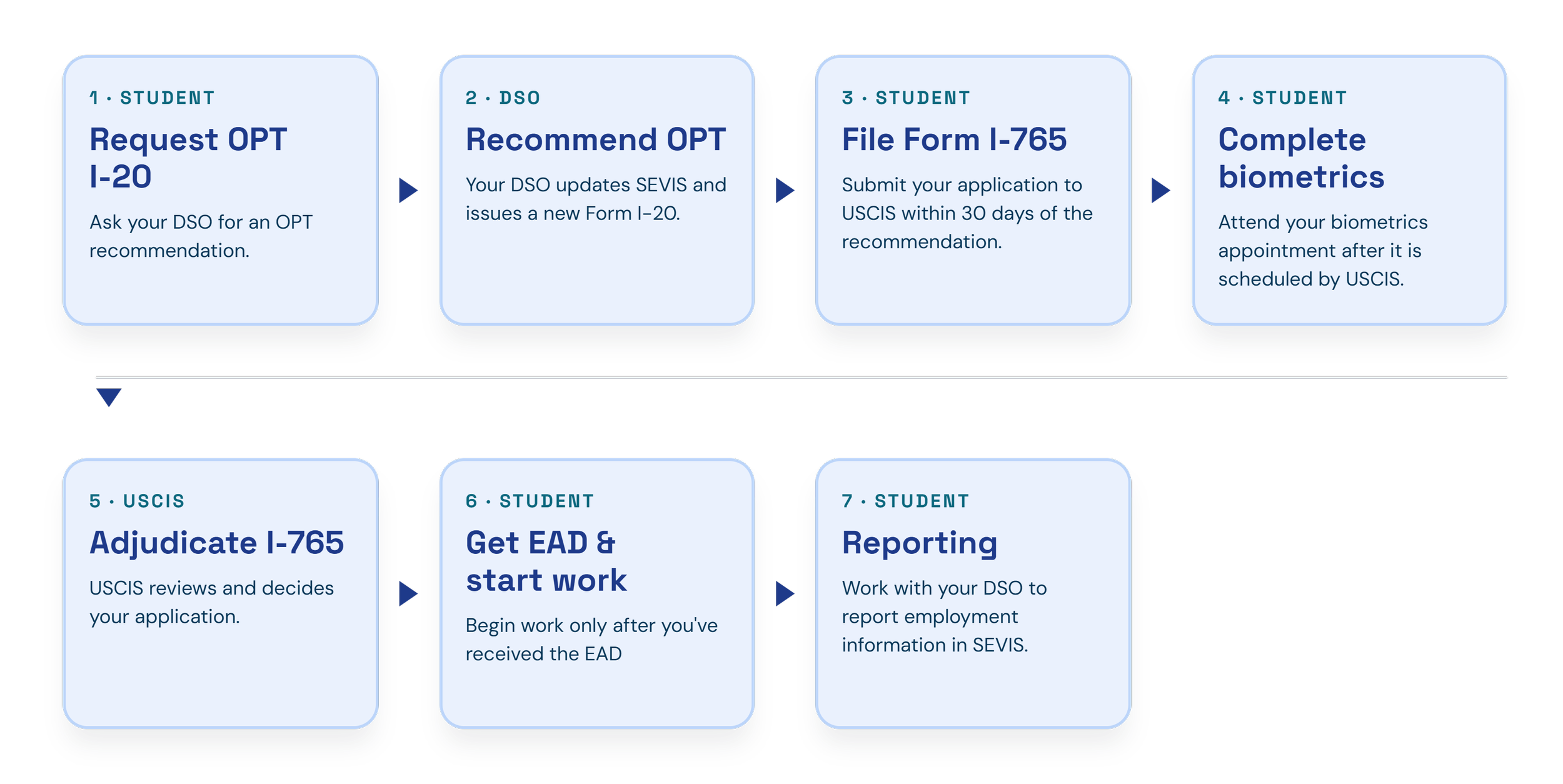
Follow your school’s process for requesting an OPT I-20
Review USCIS’ I-765 instructions
Prepare OPT application materials, which involves making digital copies of the following documents:
Filing fee (currently $470 for online filing). Payable by credit or debit card for online application
OPT I-20. Signed & dated by you, and issued less than 30 days from when you submit your I-765
Previously issued CPT or OPT I-20s (if applicable)
Previous EADs (if applicable)
Passport bio page
F-1 visa
I-94 record (get most recent Form I-94)
Pre-Completion OPT applicants - copy of your transcript or certificate of enrollment confirming full-time enrollment forone academic year or more by the start of the requested OPT
4. Create a myUSCIS account if you don’t already have one
5. Compete and submit Form I-765 ONLY AFTER having received the OPT I-20 NOTE -you must be physically present in the U.S. at the time of submitting an OPT application.
After Applying
Shortly after submitting the I-765, your I-797 Receipt Notice should be posted in your MyUSCIS account with a receipt number (i.e., IOExxxxxxxxxx). This number can be used to follow the processing of your application through USCIS’ Case Status Tracker.
Additionally, the following requests or options may become relevant to your case after submission:
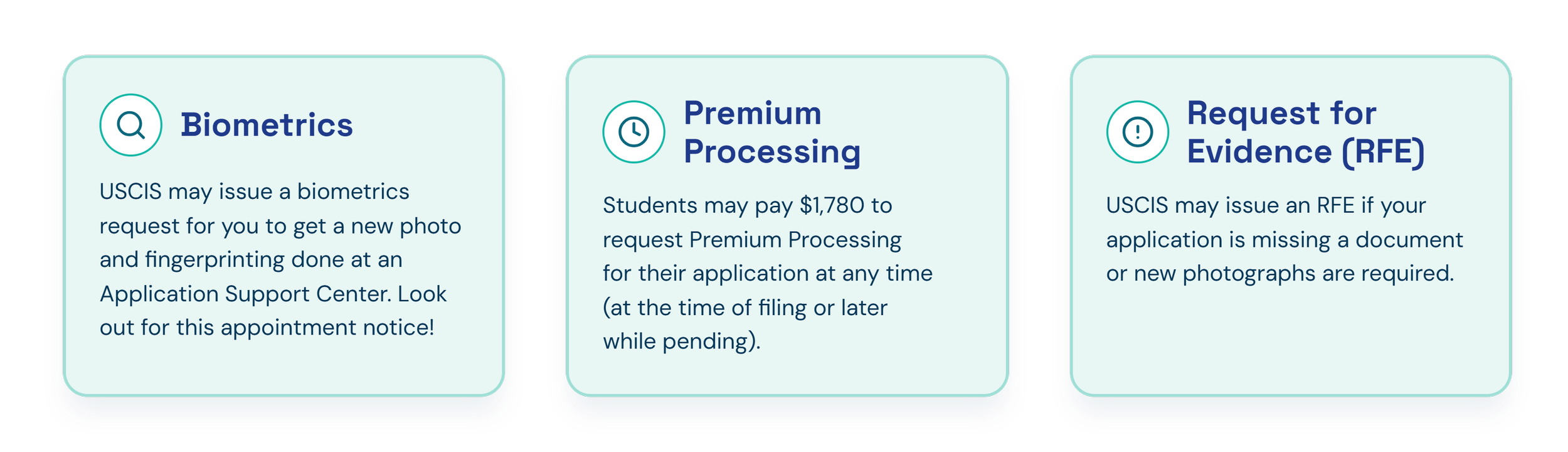
Biometrics: USCIS may require an in-person biometrics appointment if they do not have a qualifying photo already, taken in the past 3 years. In this case, USCIS will issue an appointment notice for a specific date and time at the Application Support Center closest to you. This notice should be mailed to you, as well as posted to your MyUSCIS account. Check for this notice regularly, as missing the biometrics appointment can lead to OPT application denial.
Premium Processing: You can pay the $1,780 to request premium processing with your original I-765 submission or at any point while your application is pending.
Request for Evidence (RFE): USCIS may follow up with you to request further information if something is missing from your application or if questions arise about your materials or eligibility. The RFE should be both mailed to you and posted to your MyUSCIS account. Note that an RFE doesn’t necessarily mean there is something wrong with your application - don’t panic - but it does need to be addressed relatively quickly and must be submitted within the timeframe provided. If you are issued an RFE, reach out to your DSO right away to review the request and your plan for response.
Reporting Requirements
Once approved and on post-completion OPT, certain reporting is required in order to maintain F-1 status. You’re required to report changes to any of the following, within 10 days of the change:
Legal name
Address
Employment
The SEVP Portal is where you can report these changes during OPT, though check with your school, as some schools have alternative processes that require you to report the information directly to your DSO. Regardless, do make sure to set up your SEVP Portal account. Once your OPT has been approved and the start date arrived, you should receive an email from do-not-reply.SEVP@ice.dhs.gov inviting you to create your account. Note that reporting your employment in the SEVP Portal or directly to your school is how you ensure that you aren’t accruing days of unemployment (remember the limit on unemployment days during post-completion OPT is 90).
Information you’re required to report about each employment opportunity during OPT includes:
Employer name
Employer address
Hours/week
Start date
Explanation of the relationship between the job and your academic program
Related Resources
Study in the States’ F-1 Optional Practical Training (OPT)
Troubleshooting a pending OPT? Access USCIS’ e-Requests
SEVP Portal Help Hub
